SKU: 47644730316
army white dress

army white dress Original U.S. Early WWII US Army Major's Philippine Division Tropical – International Military Antiques

Sale price$25.30 Regular price$28.11
Save 10%
Size: 4

Shipping Estimate
USA
  • USA
  • CAN

Ships within 48 hours · Estimated delivery Jul 13 - Jul 18

Promo Codes Available:

For Your Every Summer RSVP, with Code: SUMMER15

Description

army white dress Original U.S. Early WWII US Army Major's Philippine Division Tropical – International Military AntiquesOriginal Item: Only One Available. Dress whites weren't just for the Navy for much of U. S. military history. Both the Air Force and the Army sported nifty dress whites, as did the Marine Corps. The uniforms weren't just for formal ceremonies, either. They were worn as an everyday uniform for troops in tropical climates, such as, in this case, the Philippines. Air Force Chief of Staff Merrill McPeak did away with the Air Force whites in the early

Original Item: Only One Available. Dress whites weren't just for the Navy for much of U.S. military history. Both the Air Force and the Army sported nifty dress whites, as did the Marine Corps. The uniforms weren't just for formal ceremonies, either. They were worn as an everyday uniform for troops in tropical climates, such as, in this case, the Philippines.

Air Force Chief of Staff Merrill McPeak did away with the Air Force whites in the early 1990s, and the Marine Corps whites were phased out by 2000. The Army held on a little bit longer, doing away with the uniform in 2007.

This wonderful early WWII Dress White jacket belonged to a Major in the US Army’s Philippine Division. This Major, who remains unidentified due to only having a laundry number (8290A), could very well have been a victim of the atrocities committed by the Japanese after the unit’s surrender.

Units of the Philippine Division were on security missions at Manila, Fort McKinley, and Bataan prior to the declaration of war in the Pacific, 8 December 1941. After undergoing 2 days of bombings, the Division moved into the field to cover the withdrawal of troops to Bataan and to resist the enemy inthe Subic Bay area. From 11 to 23 December, positions were organized and strengthened and on 23 December the Division was assigned to the Bataan Defense Forces. While the 31st Infantry moved to the vicinity of Zig-Zag to cover the flanks of troops withdrawing from central and southern Luzon, 30 December, the rest of the Division organized the main and reserve positions on Bataan. The 31st Infantry moved to a defensive position on the west side of the Olongapo Road near Layac Junction, 5 January 1942. This junction was lost on the 6th, but the withdrawal to Bataan had been successfully concluded.

The Division was placed in reserve from 7 to 14 January 1942. This period was largely one of reconnaissance and development by the Japanese in preparation for their attack on the main battle position on the Abucay line. Elements repulsed night attacks near Abucay, 10-12 January,, and other elements of the Division counterattacked on the 16th. Strong offensive and defensive action was not able to prevent enemy penetrations and the Division withdrew to the Reserve Battle Position in the Pilar-Bagac area, 2 January. Until the latter part of March the enemy, made cautious by heavy losses, engaged in patrols and limited local attacks, and after a general retirement, 24 February, did not undertake any serious activity on this front until 28 March. During this period elements of the Division were shifted to assist in the defense of other sectors. The enemy attack on 28 March struck at a division weakened by malnutrition, sickness, and prolonged exposure to combat.

The Division, no longer operating as a coordinated unit, was unable to counterattack against heavy enemy assaults. On 8 April, the 57th Infantry and the 31st Infantry were lost near the Alangan River, and the 45th Infantry surrendered, 10 April 1942. The victory over Japan ended the misery of Japanese prison camps for the survivors of the Philippine Division.

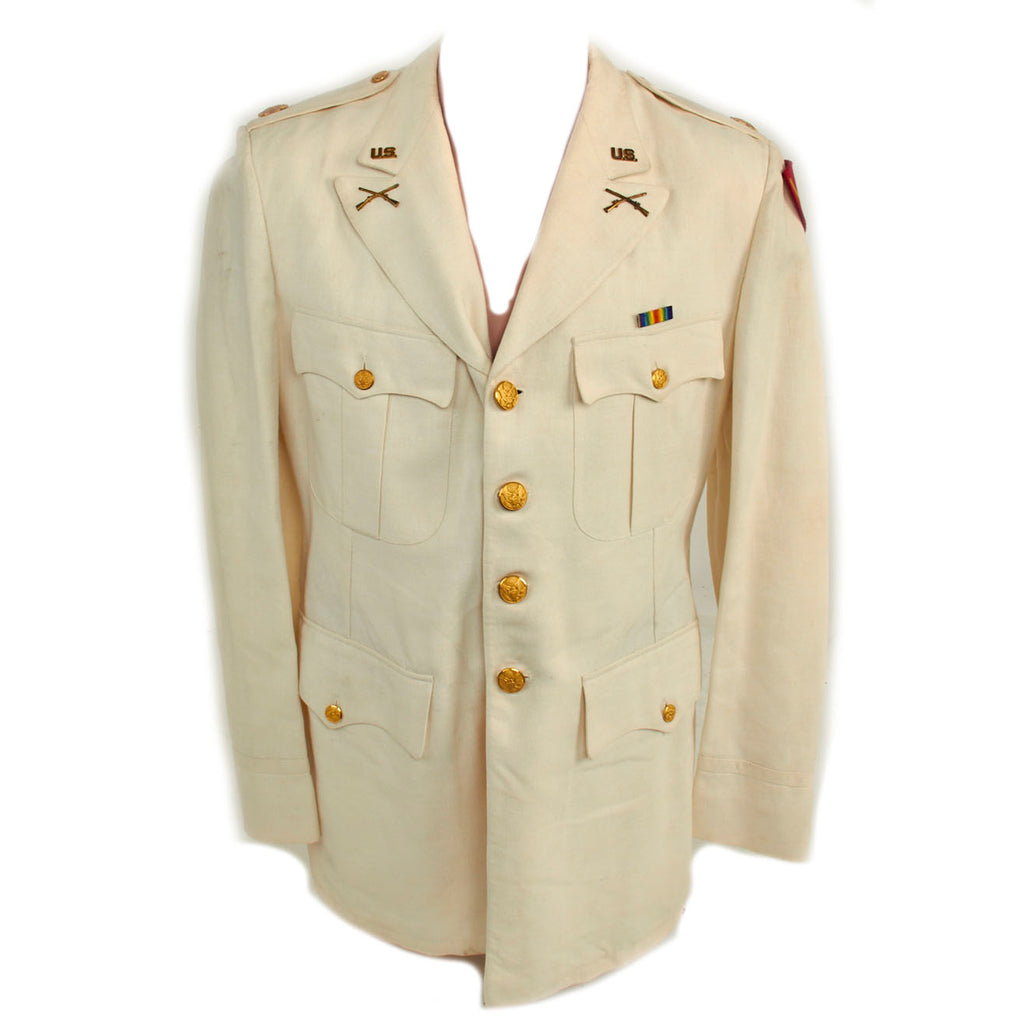
The overall condition of the uniform dress jacket is close to excellent. The white color is still very much the original color and has minimal age toning and virtually no stains present that we can find on the exterior. All buttons are present, each shoulder has a lovely bronze Oak Leaf for the rank of Major, there is a single WWI Victory Medal Ribbon located on the left front, meaning he could have been a veteran of the Great War or this was just an addition to the uniform.

The left shoulder features a lovely button on shoulder sleeve insignia. The insignia consists of a gold caboshed carabao’s head on a scarlet spade-shaped shield. The carabao is suggestive of the Philippines, and the colors red and gold represent the Spanish heritage of the islands.

This is an excellent opportunity to pick up a fantastic and rather rare US Army Tropical Dress Uniform! Comes more than ready for further research and display.

Approximate Measurements:
Collar to shoulder: 10”
Shoulder to sleeve: 26.5”
Shoulder to shoulder: 17”
Chest width: 20.5”
Waist width: 18”
Hip width: 22”
Front length: 34.5"

Shipping Notes
  • Free Standard Shipping on $100+ Orders to the USA.
  • Except Preorder products are shipped in 48 hours.
  • Delivery to the USA:
  1. Standard Shipping : 3-10 business days
  • If time is of the essence, please consider selecting expedited delivery for faster service.
Exchange/Return Notes
  • We offer a 30-day return/exchange service after receiving.
  • Final sale items are not eligible for returns or exchanges.
  • To process your return/exchange, please contact us at [email protected]
  • Please click here for more details>>> Return & Exchange Policy
SKU: 47644730316

Discover Niche Categories That Outsell army white dress

Top-Converting Item to Boost Your Average Order

4.9 ★★★★★
Based on 1432 reviews
Sort
Highest Rating
Newest First
Oldest First
Product Reviews
D
Verified Purchase
Diogenes
Phoenix, US
★★★★★ 3
Interesting read, but takes some getting used to
I heard about this book on a blog, and figured I'd check it out. It's the rambling tale of a man determined to give you every last detail of everything that might be important to the narrative of his life. Unfortunately, he goes on tangets so often that he doesn't even get to his birth for several chapters, let alone the story of the rest of his life. Along the way, you're introduced to lots of random characters who are (at best) loosely related to the protagonist, but as often as not these tangents are fairly amusing. The writing is pretty dense, and this along with the tangents had me putting the book down fairly often. It's probably ideal for a commuting book, but I never wanted to just sit down and blitz through big chunks of it. Overall it's a very different kind of experience than a novel reader typically gets. It's worth a read for a change of pace, but I can't say it's a life-altering read.
WAS THIS REVIEW HELPFUL?YesReportShare
Reviewed in the United States on March 21, 2013
J
Verified Purchase
J. W. Kennedy
Alexandria, US
★★★★★ 4
Mixed Bag
Everyone should know, first off, that the Dover thrift edition is NOT a graphic adaptation. For some reason, Amazon has attached editorial reviews from the hardcover edition of the graphic novel version to this page. Now, the book itself offers a range of experiences from delightfully hilarious to annoyingly tedious. Lots of the "funny" parts depend on an understanding of 18th-century social mores. I'm sure some of it went over my head but I'm enough of a nerd to have enjoyed most of the drollery. I think... The story is whimsical, told all out of order by a scatterbrained, easily-distracted narrator. Tristram Shandy himself is hardly in the novel at all; aside from narrating it, he only appears momentarily as a newborn infant and then as a boy about 6 years old - and his role in both incidents seems peripheral to the carryings-on of the other characters. Each turn in the story reminds the author of something else, and he turns aside to tell stories inside of stories, each of which are necessary to give the reader some vital "background information" .. with the result that the main story hardly moves forward at all. It takes nearly 200 pages just for Tristram to be born! and even then the reader isn't quite sure it has happened since the conversations and minute actions of the other characters are magnified to such an importance that the narrator's own birth is hardly observed. For the most part this rambling comes across as "quirky and delightful" and the novel flows along quite pleasingly in spite (or perhaps because) of it. The digressions add layers to the story. Except when they don't. The "chapter upon noses" which is a translation of a fictitious(?) Latin work by the great Slwakenbergius, has little bearing on the story. Like most of the book, it builds up to a climax and then stops short of resolution, leaving you to wonder what was the point. It leads nowhere, but at least it was interesting. The same cannot be said of Book VII, which is a sort of travel diary of Tristram (in the novel's "present" time) touring France by post-chaise. Although this is the only significant appearance of Tristram himself as a character in the book, it has absolutely nothing to do with the story/stories he was telling, and it is neither very interesting nor very funny. It serves as nothing but a pointless interruption, delaying the reader for 50 pages before getting to the part we were waiting for: Toby's courtship of the widow Wadman. This last section goes along nicely for a while, and then the book stops. It doesn't end; it just stops right in the middle of a conversation, with the courtship unresolved and most of the reader's questions unanswered. This is perfectly in keeping with the spirit of the entire novel, but I have to admit it's frustrating. I had trouble deciding whether to give this book 3 or 4 stars but I think it entertained me more than it exasperated me, so I'll give it the benefit of the doubt ... and round up from 3.5. It's worth reading once, just for the experience - there's no other book quite like it - and the price of the Dover Thrift Edition can't be beat.
WAS THIS REVIEW HELPFUL?YesReportShare
Reviewed in the United States on September 23, 2010
L
Verified Purchase
Lawrentius Verifer
Boise, US
★★★★★ 5
An extraordinary tale of an 18th Century family
Have you wanted to read a book where the author decides to "rip out" one of the chapters, or leaves a blank page for you to 'draw' one of the characters? Would you enjoy a story which takes many chapters before the hero manages to be born? This 18th-Century tale is touchingly told. The characters are real, and fascinating. It's not their fault that their story is frequently and impishly interrupted by outlandish "digressions" on the part of an author so creative that his modern descendants are considered to be Joyce and Beckett, as well as many others. Would you enjoy a chapter on Chapters? About buttonholes? About whether parents and their children are kin to each other? A chapter on curses? Poor Laurence Sterne has so much trouble getting two of his characters down the stairs that he finally calls in a "critic" to help! Advice on reading such an unusual, even unique, book: read the first several chapters, then stop and reread them. Continue that process and soon the book will feel quite familiar, and that's when the fun really starts. The Oxford World's Classics edition follows the first edition of the book, and is preferred. Amazon also offers the fully-annotated edition, the "Florida" edition, in three volumes. A caution about the Everyman hardcover edition: they reprinted a later edition which groups Tristram Shandy into three volumes, not nine. And then they renumbered all the chapters! That's OK unless you read secondary sources that refer you to Book VII, Chap 4: good luck ever finding it.
WAS THIS REVIEW HELPFUL?YesReportShare
Reviewed in the United States on June 4, 2000
M
Verified Purchase
Martin M. Bodek
Dallas, US
★★★★★ 1
A Total Sham-dy
What in the hell was this lunatic yammering about for all those 650 pages? What is the deal with his obession with noses, penises, and hobby-horses, hobby-horses, hobby-horses? Why does anyone consider it amusing when a writer keeps telling you he's going to get somewhere, but never does? Why is it entertaining at all to have blank chapters? Why is that cute? Why is that interesting? Who finds this funny? Who finds anything funny here at all? Why does this book of endless, mindless prattle, blabber, and piffle tickle anyone at all? Who finds digression to be enjoyable in literature? You? Why? Why? Tell me! I checked the ratings on Goodreads. This is what it showed: 5 stars: 33%, 4901 4 stars: 28%, 4064 3 stars: 22%, 3268 2 stars: 9%, 1414 1 star: 5%, 848 Meaning: 95% of these readers are flock-following, digression-loving, hobby-horse riding loonies who have swallowed the Kool-aid. There is nothing here but vacuous thundergunk. Pure, putrid unenertaining garbage. If I would have laughed once - just once - during the reading of this book, I would have given it a whole extra star, but it couldn't even do that. I give him one star for spelling Tristram's name right, and even then, it's a made-up name anyway, so I may have been hoodwinked as well.
WAS THIS REVIEW HELPFUL?YesReportShare
Reviewed in the United States on September 19, 2016
M
Verified Purchase
Michael Harold
Grantham, US
★★★★★ 5
Laurence Stern is still one of the most creative writers ever
This review is not about the words and images inside the book. This is about the fact that, when I removed the book from its packaging, the book's cover had too many creases and bends in it, both front and back, for my taste. Although I do think that Laurence Sterne might have smiled at my response, I don't think the creases were a type of samizdat (think Alexander Solzhenitsyn) added by a disgruntled/creative employee at Amazon. If this doesn't make any sense to you, or seems to be a silly mountain out of a molehill compliant, you will love the book.
WAS THIS REVIEW HELPFUL?YesReportShare
Reviewed in the United States on February 21, 2025

recommand products